On May 14, Professor Jim Gates from the University of Maryland was invited to visit Shanghai Tsung-Dao Lee Center and deliver the 32th T. D. Lee Colloquium entitled “From Parity-Violation To 4D String Theory”. Over 60 faculty members and students attended in person, including the director of SHTDLC, Academician Jie Zhang, Chair Professor Xiangdong Ji and Xiaogang He. Xiangdong Ji chaired this edition of the T. D. Lee Colloquium.
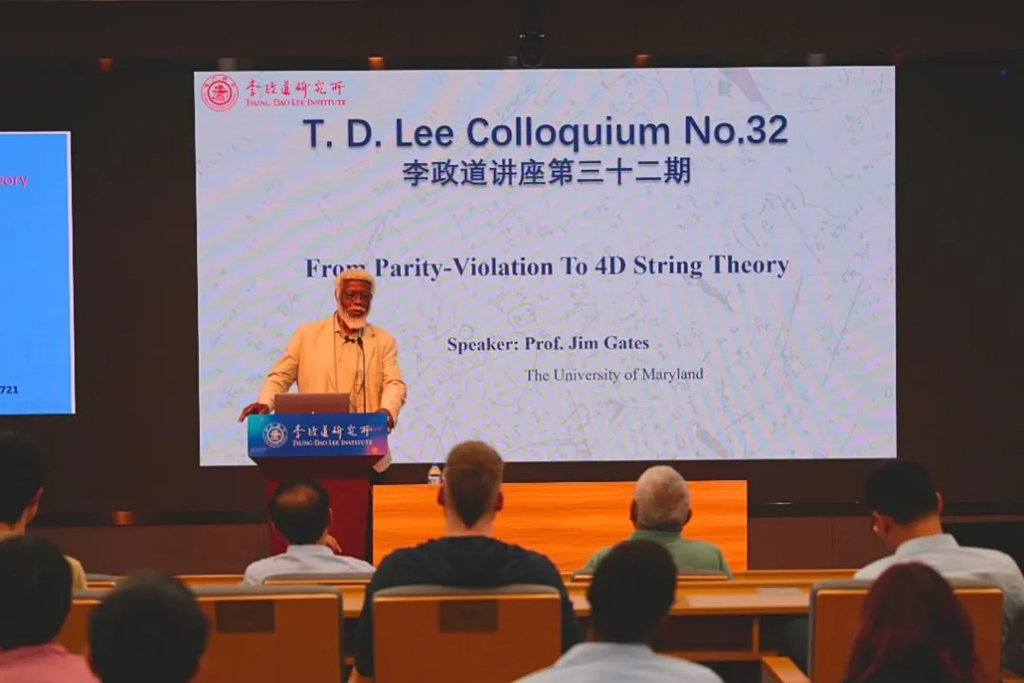
At the beginning of the lecture, Gates shared his personal journey into science, recounting his original aspirations and perseverance in research, as well as his long‑term commitment to education and his engagement with multiple academic roles. He then systematically elaborated on the physical implications of parity violation, the core essence of string theory and its mathematical foundations, comprehensively presenting the cutting-edge advances in related research and their transformative significance for the future development of physics. He delved into string theory’s ability to explain cosmic phenomena such as black holes, explored the possibility of understanding the Higgs boson within the string theory framework, and introduced the vast landscape of possible vacua in string theory—revealing both the theory’s inherent complexity and its enormous potential as a unified theory of physics.
During the Q&A session, faculty and students engaged in in-depth discussions with Gates on topics including the physical predictions of string theory and the connection between supersymmetry and quantum field theory. The discussion was lively and cordial. Drawing on his extensive research experience, Gates provided detailed responses to each question, offering valuable academic insights to the audience.
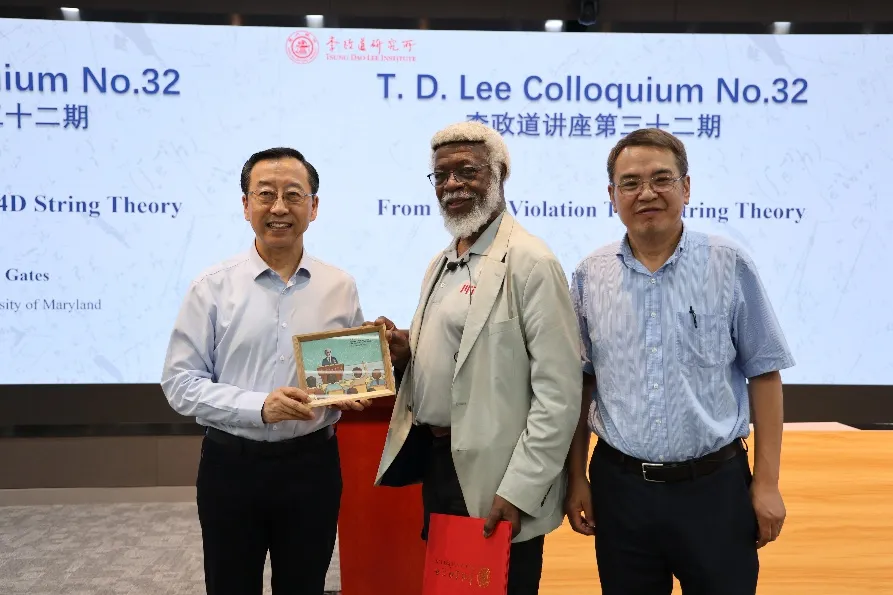
To conclude the event, Jie Zhang presented Gates with a commemorative certificate and a customized cartoon portrait on behalf of SHTDLC, thanking him for sharing his impactful research and inspiring the center’s academic community.
Biography
Jim Gates (Ph.D., MIT, 1977, Honorary Ph.D. from Harvard, 2024) is a distinguished theoretical physicist celebrated for his pioneering contributions to supersymmetry, supergravity, and superstring theory. He currently works at the intersection of physics and mathematics at the University of Maryland, College Park, where he holds the positions of Clark Leadership Chair in Science, Distinguished University Professor, and John S. Toll Professor of Physics. He also has a joint appointment as Professor of Public Policy in the School of Public Policy. Dr. Gates has won Edward A. Bouchet Award (1994), Klopsteg Memorial Award (2003) and Andrew Gemant Award (2021), and Barry Prize (2025). Among his many accolades, Professor Gates was awarded the National Medal of Science by President Barack Obama in 2013, the highest scientific honor in the United States. He is an elected member of the National Academy of Sciences—the first African American theoretical physicist elected to the Academy in its 150-year history—as well as a member of the American Academy of Arts and Sciences and the American Philosophical Society. He is also a Fellow of the American Mathematical Society and American Physical Society — a dual recognition given to less then one percent of U.S. researchers. Beyond his research, Gates is a dedicated public servant and advocate for science education. He has served on the U.S. President’s Council of Advisors on Science and Technology (PCAST) and the Maryland State Board of Education. He is a past President of the American Physical Society (APS) and a Fellow of numerous organizations, including the American Association for the Advancement of Science and the National Society of Black Physicists.